REVIEW · HISTORICAL TOURS
Da Nang War Tour History: Spanish-French Attack to American Base
Book on Viator →Operated by Hung Le Travel-The Local Signature · Bookable on Viator
War leaves fingerprints on places, and Da Nang shows them fast. This day tour threads major conflict eras into real stops, from French-Spanish-era locations to American Vietnam War sites, then balances it with temples and culture. I especially like the English-speaking guide approach (patient, photo-friendly, and willing to explain) and the way the route pairs battlefield storytelling with scenic viewpoints like Hai Van and Son Tra. One drawback: it’s a long 9 to 10 hour stretch, so comfortable shoes matter.
I also like that this is designed as a private experience for your group, with round-trip car pickup available depending on your option. It’s priced low for a full-day itinerary, and most ticket costs are handled for you (again, depending on your selected option). The key thing to consider is that several parts of the day involve walking on-site, plus caves/temple areas, so if you’re sensitive to stairs or uneven surfaces, plan smart.
In This Review
- Key highlights at a glance
- Da Nang War Tour History: how this route turns facts into place
- Marble Mountains: caves, temples, and the first “wow” of the day
- Hai Van Pass and Hai Van Tower: why 1858 mattered for Hue
- Son Tra Peninsula: American Radar, an old landing zone, and the Spanish Cemetery
- Lady Buddha at Bai But Pagoda: the 67-meter pause from war talk
- Da Nang Museum of Cham Sculpture: the older roots behind the scenery
- Timing, transport, and what a 9 to 10 hour day feels like
- Price and included tickets: is $29 good value?
- What makes this tour feel human: guides and the photo factor
- Who should book this tour (and who might skip it)
- Should you book this Da Nang war-history day tour?
- FAQ
- How long is the Da Nang War Tour History experience?
- How much does the tour cost?
- Is hotel pickup or round-trip transfer included?
- Is this tour private?
- What entrance fees are included?
- Are meals included?
- What should I bring for the day?
- Does it run in bad weather?
- What is the cancellation rule?
Key highlights at a glance

- Marble Mountains’ caves and temples: a dramatic start with centuries-old spaces
- Hai Van Tower story at the pass: why local powers built fortification in 1858
- American Radar and Landing Zone area: WWII-to-Vietnam-era military tech and layouts
- Spanish Cemetery with about 400 names: a heavy stop that grounds the timeline
- Lady Buddha at Bai But Pagoda: 67 meters of calm above Son Tra
- Cham Museum focus: Hindu sculpture that anchors the region before and around conflict
Da Nang War Tour History: how this route turns facts into place
Da Nang can feel like a modern beach city until you remember it sits on a strategic coastline. This tour leans into that reality. It connects several eras that overlapped here: older Champa influence, then conflict stretching through French and Spanish involvement in the 1800s, and later the American Vietnam War footprint.
What makes the experience useful for you is the pacing. You’re not just reading dates; you’re standing in the geography that made decisions possible. Then you get a contrast built in: religious sites and scenic passes, where the views help you understand why both armies and kingdoms wanted control of these high spots and coastal approaches.
And yes, the tone can get emotional. The Spanish Cemetery stop, for example, is about loss with a clear human count. If you prefer history with context rather than a quick checklist, this route fits.
You can also read our reviews of more historical tours in Da Nang


Marble Mountains: caves, temples, and the first “wow” of the day

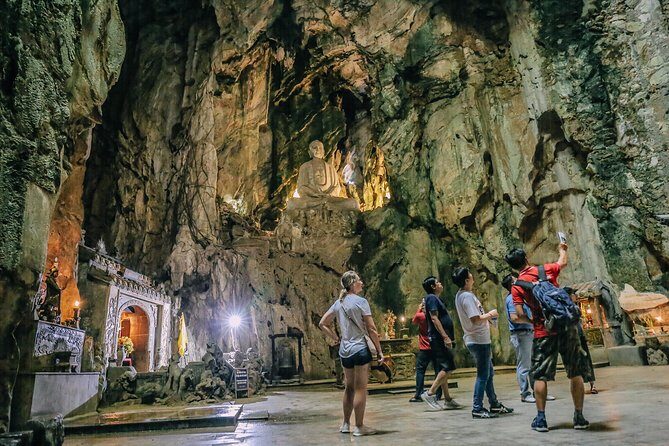
Marble Mountains is the kind of start that wakes up your senses. You get about 2 hours here, and the focus is on caves and temple areas inside the mountain. It’s not only scenic. The place has been worked and worshiped for a long time, so it gives you a sense of continuity before the tour shifts into war-era stories later.
What to expect:
- A lot of walking in and around cave-temple spaces
- Temples and smaller nooks that reward slow looking
- Sculpturing-related activity in the area, which adds a craft dimension
A practical tip: if you’re planning photos, bring a phone camera strap or keep your hands free on uneven ground. Cave entrances can feel cooler and darker, so your screen brightness will need a quick adjustment.
Potential drawback: cave and temple visits naturally mean uneven steps. If you’re traveling with mobility limits, tell your guide early and move carefully. This part is still worth it, but you’ll enjoy it more if you plan for slow movement.
Hai Van Pass and Hai Van Tower: why 1858 mattered for Hue
Next comes Hai Van Pass, one of Vietnam’s famous stretches of road where the geography does half the storytelling. You also visit Hai Van Tower, with the tour linking it to a specific 1858 event and the goal of protecting Hue Imperial from French attack.
Why this stop matters to your understanding:
- Passes are control points. Whoever holds them influences travel, supply, and timing.
- Fortification choices reflect fear and strategy, not just engineering.
You’ll get about 2 hours here, including time at the tower and time to access the peak area. That access part is important. Even if you’re not a “view person,” seeing the pass from above helps you understand why someone would build defenses here.
One more thing: the tower and pass area can feel breezy and changeable. If you’re sensitive to weather, pack a light layer.
Son Tra Peninsula: American Radar, an old landing zone, and the Spanish Cemetery

Son Tra Peninsula is where the tour really shifts from “general war talk” to identifiable Vietnam War-era references. This is the biggest storytelling block in the middle of the day, with about 3 hours here.
You’ll drive up to American Radar, described as the Magic Eyes of Indochina, and you’ll also see the American Landing Zone with a helicopter-airport serving location during the Vietnam War. Even if you don’t know military terminology, the tour’s strength is how it points you to the purpose of each site. Radar and landing zones aren’t abstract concepts; they’re physical installations shaped by the landscape.
Then the day turns heavier. You go down from the peninsula area to the Spanish Cemetery, connected to the French-Spanish campaign period. The tour description highlights that around 400 Spanish and French soldiers lost their lives in Indochina, and that scale is part of why this stop lands emotionally.
What I’d recommend for you during this portion:
- Slow down at the cemetery. Read what you can, even if you don’t stay long.
- Ask your guide to explain how the peninsula’s geography relates to both radar/landing positions and the earlier French-Spanish context.
Possible drawback: this section is information-heavy. If you want pictures, you’ll need to pause your listening at certain points so you don’t miss the guide’s key explanations.
Lady Buddha at Bai But Pagoda: the 67-meter pause from war talk

After the Vietnam War sites and the cemetery, Lady Buddha at Bai But Pagoda gives you a psychological reset without breaking the tour’s logic. This stop is only about 1 hour, but the location helps. You’re on the same Son Tra peninsula context, yet the focus becomes religious space and a big visual anchor: Lady Buddha is listed at 67 meters tall.
Why it’s worth your time even if you don’t “do temples”:
- It gives you a sense of how people reclaim the same landscapes that were once focused on conflict.
- The scale of the statue helps you orient spatially. You get another way to read the peninsula beyond military function.
If you like photographs, this is a good spot for a few steady shots rather than a fast sprint. The area can still involve walking, so keep your energy for the earlier climb and schedule this stop as your “recharge.”





Da Nang Museum of Cham Sculpture: the older roots behind the scenery

To keep the day from feeling only war-focused, the final major cultural stop is the Da Nang Museum of Cham Sculpture. This museum centers on Hinduism sculpture from the Champa kingdom, with a collection that’s described here as about 250 statues ranging from the 2nd to 17th centuries.
The practical value for you is that it adds depth. Even if the rest of the day centers on 1858 and the Vietnam War, you’ll get a clearer picture of why Da Nang and central Vietnam mattered long before those later conflicts.
What to expect in about 1 hour:
- Hindu-style sculpture display
- A clear theme (Cham/Hindu art rather than a random mix of artifacts)
- A better understanding of regional cultural identity
If you’re short on time in Da Nang and worry you’ll miss the “real Vietnam” outside beaches, this museum is the counterweight. It helps you understand that conflict didn’t erase earlier culture—it layered over it.
Timing, transport, and what a 9 to 10 hour day feels like

This tour runs roughly 9 to 10 hours. That length can work really well if you treat it as one long story arc: start with Marble Mountains, move through Hai Van, then spend the middle on Son Tra war-era sites, and wrap with museum culture.
Transport is typically part of the value. The tour offers round-trip transfer by modern private car depending on your option. That matters because Da Nang traffic and distances can eat time fast if you’re arranging things independently.
A few practical considerations:
- Wear closed-toe shoes. Caves and uneven surfaces happen.
- Bring a light layer for Hai Van and Son Tra, since wind and shade can vary.
- Stay hydrated. Mineral water is included.
Also, this experience depends on good weather. If conditions are poor, you should expect the operator to offer a different date or a full refund, so keep an eye on the forecast the day before.
Price and included tickets: is $29 good value?

At $29 per person, this is priced like a “budget-friendly” full-day history tour. The value comes from what’s handled for you.
Included items (depending on your option) cover several admissions:
- Cham Museum entrance tickets
- Military museum entrance tickets
- Marble Mountains entrance tickets
- Hai Van Pass Tower
- American Landing Zone
- American Radar area access (where applicable to the option)
- Mineral water
You also get a private certificate English-speaking guide, plus (depending on option) round-trip transfer.
Here’s how to think about the math: if you were trying to piece together Marble Mountains, Hai Van Tower, Son Tra military-area access, and a museum separately, you’d likely spend more time and more money than the tour price. The car transfer and multiple tickets are doing real work for you.
The main things not included are tips/personal expenses, and any meals and travel insurance. In other words, you’re mostly paying for transport + sites + guide, not for food.
Possible consideration: since some ticket entries are listed as depending on the option you choose, confirm what’s included in your exact booking. That’s the only way to guarantee the day matches your expectations.
What makes this tour feel human: guides and the photo factor
The best part of this kind of tour is the “why,” not the “what.” The tour is built for explanations at each stop: why An Nam Kingdom built fortification in 1858, what radar and landing-zone functions meant during the Vietnam War, and how Cham art reflects a deep cultural layer.
The guide factor also shows up in the reviews. Hung Le Travel lists Hung Le Travel–The Local Signature, and one highlighted guide name is Hung Le. Feedback points to the guide being patient with questions and enthusiastic about sharing context, plus helping with precious photo moments.
Even if you’re not traveling for photos, a guide who understands pacing can make the difference between a confusing day and a memorable one. When your guide offers you photo time, take it. Those stops are the kind where you’ll want evidence later.
Who should book this tour (and who might skip it)
This is a good match if:
- You like history that’s tied to geography
- You want a single-day route that covers French-Spanish and American-era references
- You also want culture at the end, not just war sites
- You prefer a private group experience rather than joining a huge bus
You might reconsider if:
- You hate long days with lots of walking
- You’re looking for only relaxing sightseeing and beach time
- You need meal inclusions (meals are not included here)
Should you book this Da Nang war-history day tour?
I’d book it if you want a structured day that makes conflict-era Da Nang understandable without turning into a gloomy lecture. The mix of Marble Mountains + Hai Van + Son Tra military references + Cham culture gives you both context and contrast. At $29, the admissions and car transfer value is hard to beat, as long as you pick the right option so ticket inclusions match what you want.
If you’re planning your first day in Da Nang, this tour can help you get your bearings fast—both literally (pass and peninsula viewpoints) and historically (how the coastline pulled everyone in). Just plan for the full-day pace and wear shoes you trust.
FAQ
How long is the Da Nang War Tour History experience?
It runs about 9 to 10 hours.
How much does the tour cost?
The listed price is $29.00 per person.
Is hotel pickup or round-trip transfer included?
Pickup and round-trip transfer by modern private car are offered depending on your option.
Is this tour private?
Yes. It’s described as private, with only your group participating.
What entrance fees are included?
Cham Museum entrance tickets and several military/cultural/site tickets are included depending on your selected option (and Marble Mountains and Hai Van Tower tickets are also listed as depending on option).
Are meals included?
No. Meals are not included.
What should I bring for the day?
Wear comfortable shoes for walking around caves/temple and viewpoint areas, and bring your own snacks if you’re the kind of person who needs regular food breaks. Mineral water is included.
Does it run in bad weather?
This experience requires good weather. If it’s canceled due to poor weather, you’ll be offered a different date or a full refund.
What is the cancellation rule?
Free cancellation is available up to 24 hours in advance for a full refund.
If you want, tell me your travel month and whether you prefer more walking or more viewpoints, and I’ll suggest how to pace each stop so the long day feels manageable.